Answers link to their sources, agents log what they were thinking, and every number comes with the measurement behind it. I build knowledge graphs, agents, and production ML that way, start to finish, on my own. Orpheus, an explorable atlas of 40,000 artists and nearly 2,900 musical styles, went live in May 2026. Pythia, an oracle over the same graph that cites every claim, went live in August with its evaluation published. Walk in, or ask.
Route-design software I led, deployed nationally by La Poste and run for a decade.
Neural-network risk scoring for KnowBe4’s security-awareness platform; granted US patent 10,673,876.
A model of the US Navy’s entire enlisted workforce, calibrated against reality.
Pythia’s evaluation existed before the system did: 115 gold questions, recall@10 0.89 at launch, blind spots written down beside the score.
In the myth, Daedalus is the craftsman who built the labyrinth. In this studio the labyrinth is data, most of it contradictory and unmapped. Each project builds a structure inside it and hands you the thread.
The first project family maps musical culture, in stages. Knossos, the data core, reconciles four sources into one graph. Orpheus lets you walk it: 43,000 rooms. Minotaur is an agent that audits the rooms and writes down why it flagged what it flagged. Pythia answers questions over the graph, with an evaluation you can read. Lyre, next, puts browsing and asking on one screen. There’s a longer list waiting, and music is only the first domain.
One person, end to end: the schema, the pipeline, the agent, the interface, and the linocut stamps in the corners of the UI.
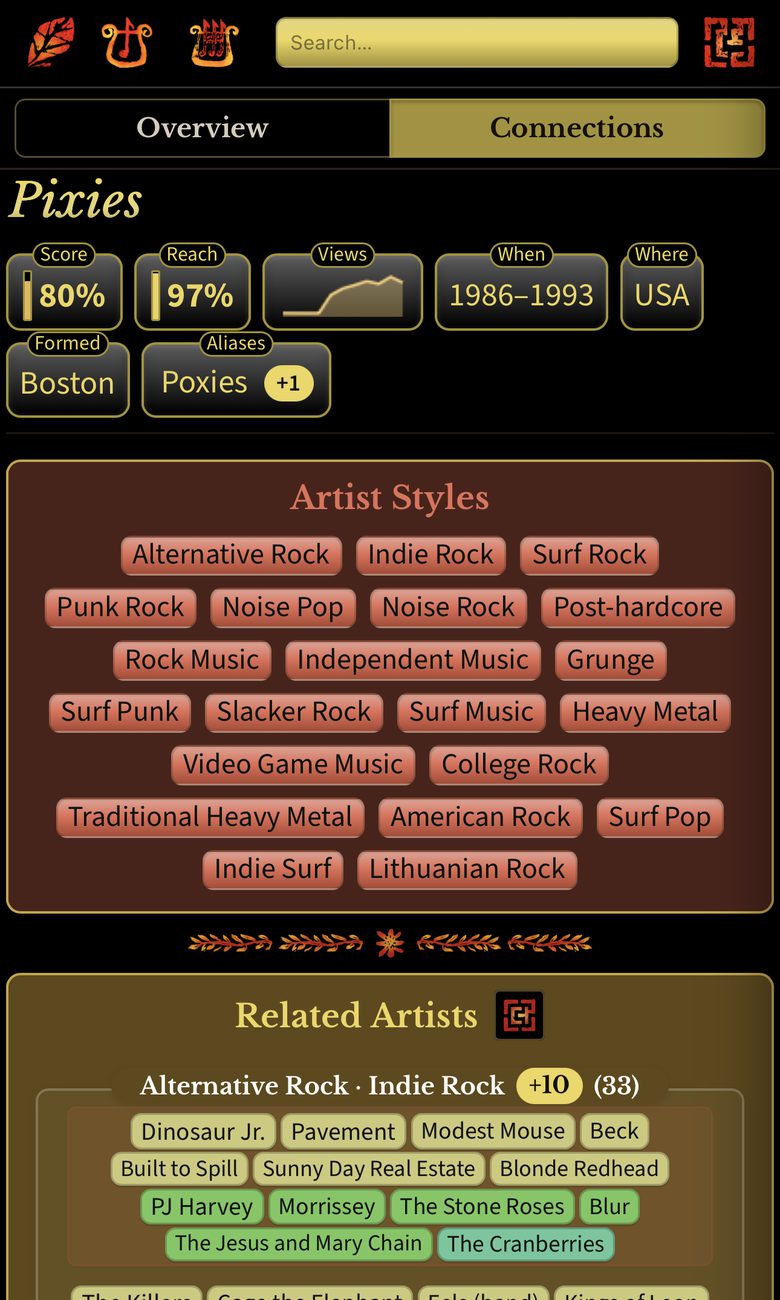
Five notes so far. Start with Four sources that disagreed, on what to build when Wikipedia, Wikidata, MusicBrainz and Spotify cannot agree who an artist is. All notes →
For teams whose data is blocking the roadmap, whose agents have to hold up in front of customers, or whose AI bills nobody can explain.
Four conflicting sources reconciled into one coherent schema, with entity resolution that holds at 40,000 entities. If your data is heterogeneous and it is holding up the roadmap, that is what I do.
Agents that do a job and show their reasoning. I’ve built two from scratch: an auditor that invents its own issue taxonomy and logs every step, and an oracle that cites every claim and shipped with its evaluation published. If your team is designing agent infrastructure, I’ve already made the mistakes worth paying for.
Twenty-five years of production ML (patents, systems serving millions of users, fleet-scale monitoring), a few days a month, no full-time hire.
I was born in Paris and grew up in Ouagadougou, Kinshasa, Lomé, and Dakar. I did a PhD in neural networks in the 1990s, then spent twenty-five years making complex systems legible for the US Navy, the French post office, a Fortune 500 insurer, and an 8-million-user security platform. I speak French, collect bandes dessinées, and carve linoleum.
I built Orpheus because music always felt like a vast, ungraspable space, and I wanted to map it. And because the best cure for “what should I listen to?” is a maze: start at a musician or style you love and see where it takes you.
I take a few engagements a year, and only the interesting ones. The fastest way to find out whether yours is one of them is a conversation.